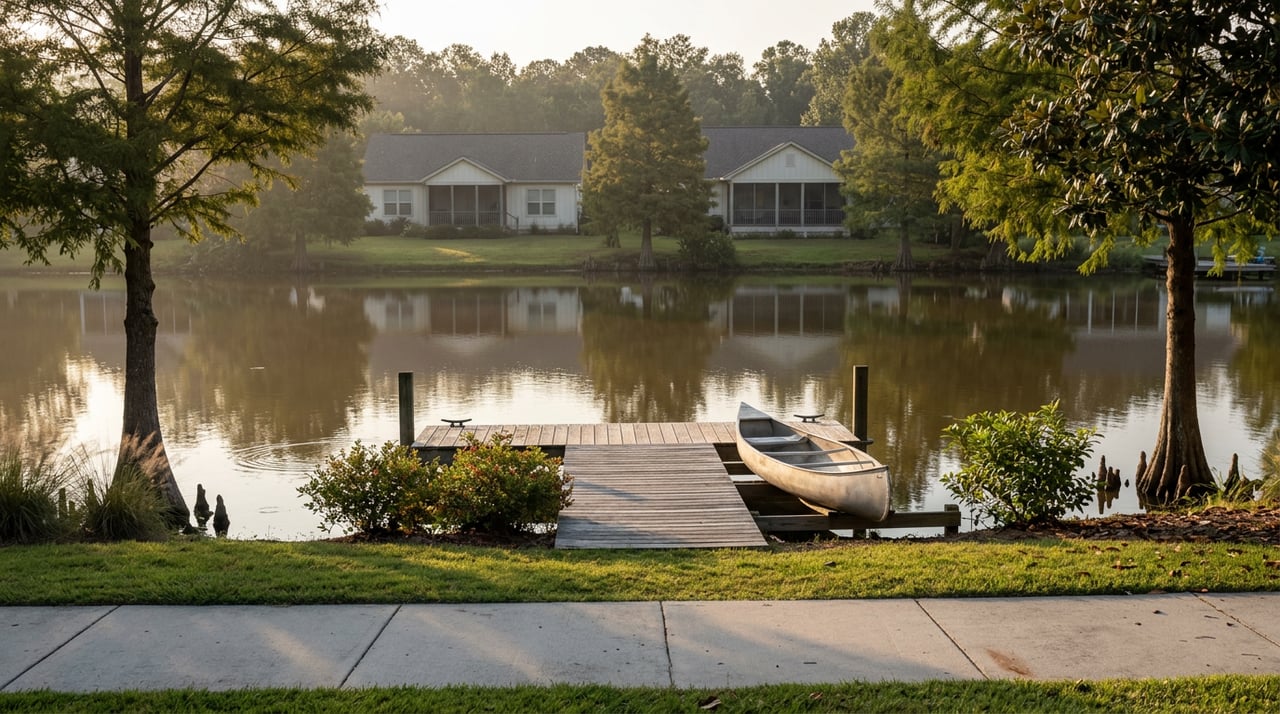
Walk the loop at Wellsgate before eight on a Saturday and you will notice what is missing before you notice what is there. No outboard motor cutting across the water. No wake slapping the bank. Just a kayak paddle dipping in and out, a heron working the shoreline, and the sound of your own shoes on the path. Someone in waders is already thigh-deep near the levee, casting toward a stump bed. A stroller rolls past without anyone needing to step aside for a boat trailer backing down a ramp.
That quiet is not an accident of geography. It is the result of a single rule written into the neighborhood's covenants, and once you know what that rule does, you start noticing it everywhere on the water.
The Rule Nobody Reads Twice
Every homeowner in Wellsgate pays into an HOA that funds upkeep of the lake and common grounds, and buried in those governing documents is a restriction that shapes the entire character of the place: no gas-powered engines on the water. Kayaks, canoes, and electric trolling motors are fine. A bass boat with a 150-horsepower outboard is not.
Most new residents skim past this line when they close on a house. It reads like a minor HOA footnote next to lawn maintenance rules and fence height limits. But this is the clause doing the real work. It is the reason the 130-acre lake at the center of the neighborhood functions as both a fitness loop and a fishery at the same time, without one activity crowding out the other.
Why the Loop Feels Longer Than 1.5 Miles
The path around the lake runs about a mile and a half, and it is the closest thing Wellsgate has to a town square. Families push strollers on it in the morning. Retirees walk it after dinner. Because there is no engine noise bouncing off the water and no wake to watch for from the bank, the path never competes with the lake itself for attention. You can hold a conversation at normal volume the entire way around.
The loop threads past two condo communities built right into the shoreline. Stonebridge, a collection of single-level duplex and four-plex units, was designed for residents who want lake access without the upkeep of a full yard. The Retreats sits closer to the water and leans toward weekenders, people who want a place at Wellsgate without making it their only address. Both communities exist because the lake made this stretch of land worth building on differently than the rest of the neighborhood. Neither would function the way it does if the water in front of it were churned up by boat traffic all day.
The Bass Get the Same Deal the Walkers Do
The lake carries a reputation among residents for serious largemouth bass, including fish weighing in the double digits. That is not a coincidence tied to the electric-only rule either. Bass spawn in shallow, calm water, and repeated boat wake near the banks disturbs spawning beds and pushes fish toward deeper, harder-to-reach water. A lake without gas engines keeps the shallows undisturbed, which is exactly where a lot of the best fishing happens.
If you want to get a boat on the water yourself, there is a concrete ramp on the levee built to handle craft of different sizes, though the same electric-only rule applies once you are past the ramp. It is a small detail that matters if you have out-of-town guests who assume every neighborhood lake works like the ones with marinas and jet ski rentals. This one does not, and that is the point.
For comparison, The Highlands community on the east side of Oxford has its own lake, about 80 acres surrounded by wooded walking trails. Wellsgate's is bigger, sits on the west side of town off Highway 6, and was built around the loop-and-fishery model rather than a trail-through-the-woods model. Oxford has more than one version of "lake neighborhood," and the covenant is a big part of what separates them.
What's Actually Allowed on the Water
For residents who get asked this by visiting family, the short version:
- Kayaks and canoes, no restriction
- Electric trolling motors, permitted
- Gas-powered engines, not permitted under the neighborhood's covenants
- Fishing, open to any Wellsgate homeowner
- Launch point, the concrete ramp on the levee
Where the Loop Ends
Most walks around the lake end the same way, with a stop at the Wellsgate Shoppes near the main entrance or a short drive out to the cluster of restaurants along Highway 6 just outside the neighborhood. It is a small stretch of casual cafes and Southern-style spots, close enough that nobody plans an evening around the drive. The lake gets you moving in the morning. The strip on Highway 6 is where the day usually closes out.
None of this is dramatic. There is no ribbon-cutting attached to a covenant clause about engine horsepower. But it explains something residents feel every time they walk the loop or drop a line in the water without quite having the words for it. Wellsgate's lake works the way it does in part because a rule written into the HOA decades ago restricts which kinds of boats can use it.
If you are weighing what a neighborhood like this actually offers a family member or friend thinking about Oxford, or you just want a second opinion on how a place like Wellsgate compares to other lake-adjacent spots around Oxford, Zach Callicutt knows these covenants and these streets well enough to walk you through the parts that don't show up on a listing sheet. Book an appointment when you're ready to talk specifics.
This article is general information, not legal, tax or financial advice. Consult a qualified professional about your situation.